Nirmal "Nimsdai" Purja
The world remembers the people who stand on the summit. Nims Purja spent his career making sure we also remembered the people who made the summit possible.
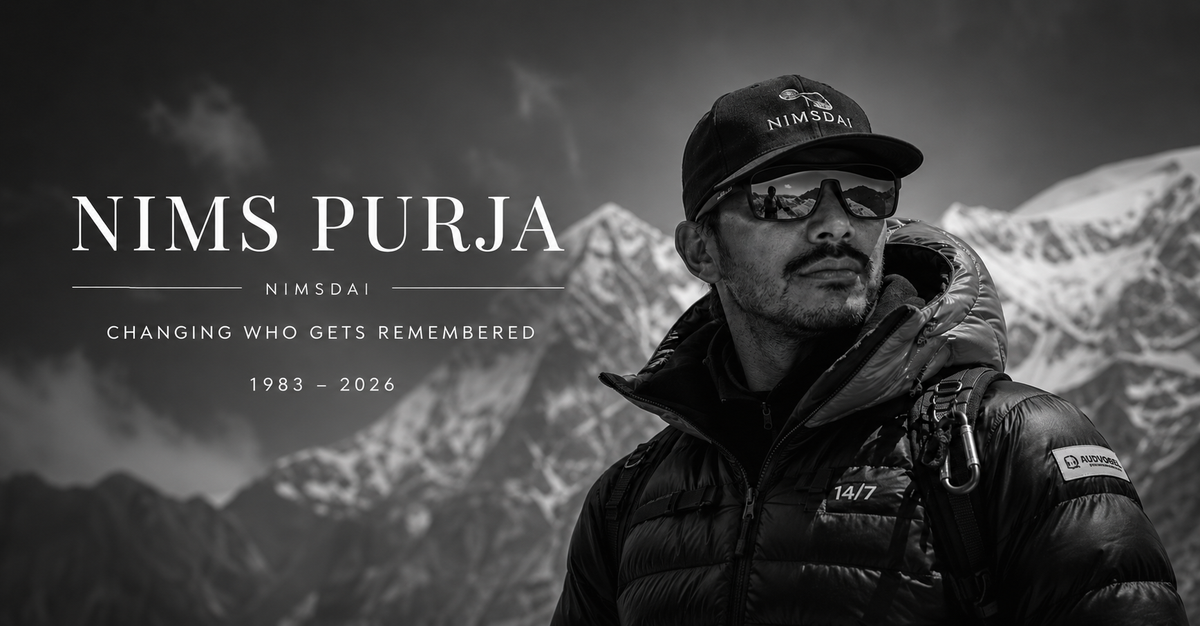
Nirmal "Nimsdai" Purja spent his life in the death zone, pushing the limits of what was possible on the world's highest mountains. This week, he and nine fellow climbers lost their lives in an avalanche on Broad Peak in Pakistan.
It brought to an end one of mountaineering's most extraordinary careers, and prompted tributes from around the world to a man whose achievements repeatedly redefined what was thought possible.
It would be easy to remember him simply as the climber who broke records. It would also miss the point.
Because the most important thing Nims achieved wasn't reaching summits faster than anyone before him. It was changing who the world noticed when those summits were reached.
Project Possible
In 2019, Nims announced what sounded like fantasy.
He would climb all fourteen of the world's mountains above 8,000 metres in less than seven months. The existing record stood at almost eight years.
Even experienced climbers questioned whether it could be done. The logistics alone seemed overwhelming. Weather windows are narrow, conditions unpredictable, and each mountain presents its own unique dangers.
Nims completed the challenge in six months and six days.
Project Possible instantly became one of the greatest accomplishments in the history of mountaineering, not simply because it was faster than anyone imagined, but because it expanded the boundaries of what people believed a human being could achieve.
For many athletes, that would have been enough but for Nims, it was the beginning of something bigger.
Project Possible did more than rewrite the record books. It redefined what elite Himalayan climbing could look like. Just four years later, Kristin Harila and Tenjen "Lama" Sherpa completed all fourteen 8,000-metre peaks in just 92 days, surpassing Nims's time. Their achievement didn't diminish what Nims had accomplished; it demonstrated how completely he had reshaped perceptions of what was possible.
More significantly, it reflected another shift Nims had championed. Tenjen Sherpa wasn't presented simply as someone helping another climber make history. He was recognised as an equal partner in one of the greatest achievements mountaineering has ever seen.
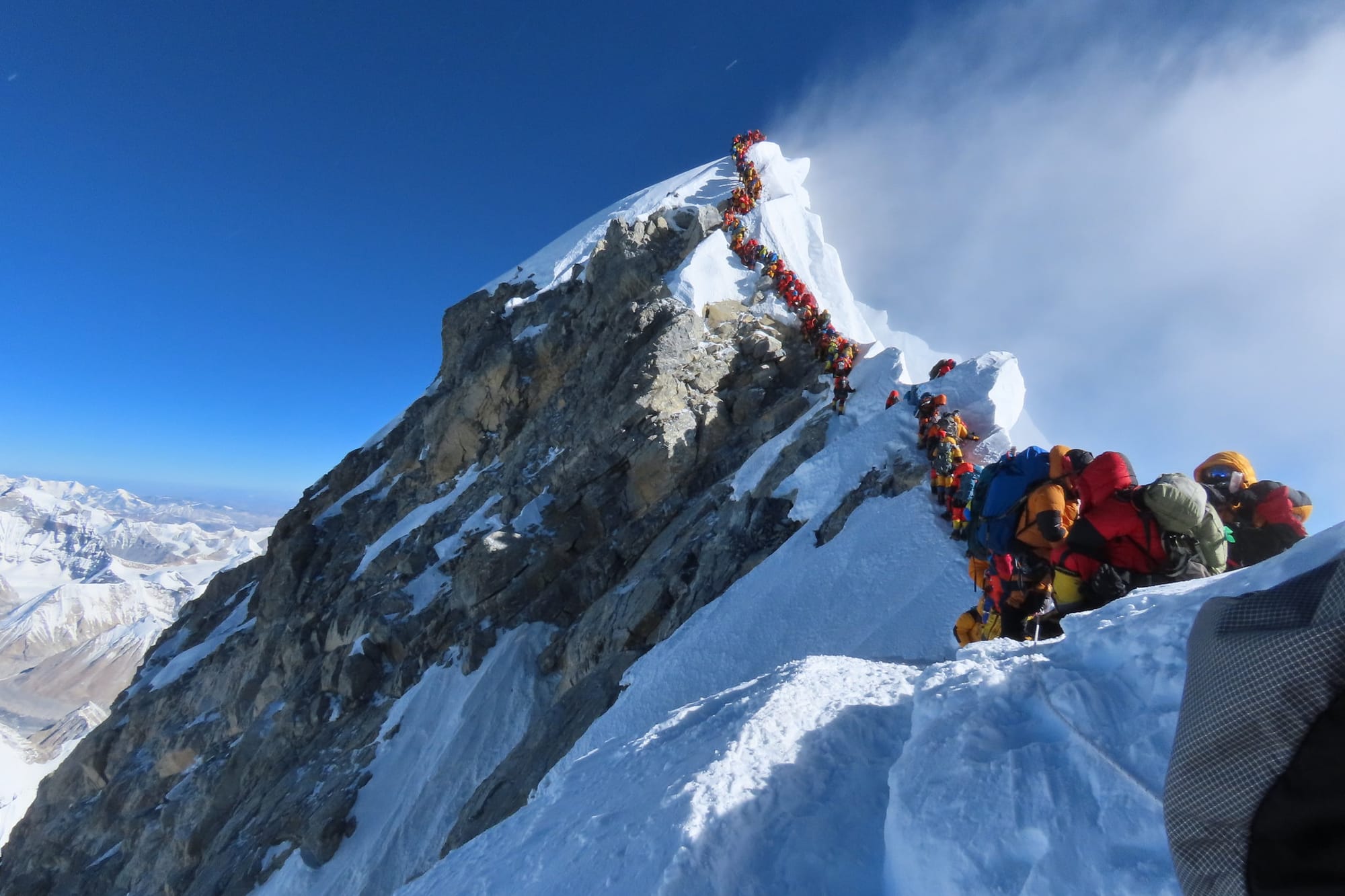
While descending from the summit of Mount Everest during Project Possible, Nims's photograph hundreds of climbers queuing on the Hilary Step. The photo was shared on his Instagram account and instantly went viral. It became one of the defining images of modern Himalayan climbing, not because it showed a summit, but because it revealed the reality behind it.
The People Behind Every Summit
For generations, Himalayan mountaineering has tended to tell a familiar story. A celebrated climber stands on the summit. Their photograph appears on magazine covers. Their name enters the history books.
Far less attention is paid to the people who fixed ropes through dangerous terrain, carried equipment to high camps, broke trail after fresh snowfall, navigated objective hazards, and often accepted the greatest risks long before the summit bid even began.
Sherpas have always been central to Himalayan climbing. Too often, they were treated as supporting characters. Nims knew that story from the inside.
Born in Nepal, he served in the Gurkhas before becoming the first Gurkha to pass selection for the UK Special Boat Service. When he turned to mountaineering, he understood both worlds: the Western audiences who celebrated expeditions, and the Nepali climbers whose contributions were too often overlooked.
He decided to change the narrative.
Sharing The Spotlight
Throughout his expeditions, Nims consistently put his teammates front and centre. Photographs were rarely about one man standing alone on a summit. Interviews acknowledged the wider team and films celebrated the expertise of Nepali climbers alongside his own.
His guiding company, Elite Exped, continued that philosophy, showcasing Nepali leadership and demonstrating that the world's finest high-altitude climbers were not merely supporting Western expeditions, they were leading them.
Perhaps that seems obvious today but it wasn't always.
Much of mountaineering's popular history has been written through the achievements of explorers from Europe and North America. Sherpas were frequently described as guides, porters or support staff, despite possessing extraordinary technical ability, intimate local knowledge and an unmatched understanding of the world's highest mountains.
Nims challenged that imbalance simply by refusing to tell the old story.
Excellence With A Purpose
What made Nims unusual was that he understood the power of achievement. Breaking records earned headlines, headlines created attention and that attention created an opportunity to say something bigger.
Project Possible wasn't only an athletic accomplishment. It became a platform from which Nims could champion Nepali climbers and demand recognition for people who had spent decades making other people's dreams possible.
His own success became evidence of what had always been true. Sherpas weren't exceptional because they helped the world's greatest climbers. They were among the world's greatest climbers.
Beyond The Summit
Every successful expedition depends on people whose names rarely appear in the headlines. The climber standing on the summit may be the face of the achievement, but behind them are route setters, high-altitude guides, logistics coordinators, cooks, porters, meteorologists and medics. Remove any one of them and the summit may never happen.
Nims understood that reality better than most. He wasn't trying to diminish the climber at the top of the mountain. He was trying to make sure the world finally recognised everyone else who helped them get there.
His records will stand in the history books, and others will continue to push the boundaries of what is possible.
His greater achievement may prove harder to surpass. He helped change who the world chose to notice.
Because sometimes the story isn't about the person standing on the summit. It's about the people who made the summit possible.
This piece is dedicated to the memory of Nims Purja and all those who lost their lives on Broad Peak, and to the extraordinary Sherpa climbers whose skill, courage and dedication he spent his career bringing into the spotlight.